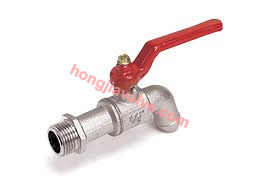
A bibcock valve is often positioned at a practical point in a water system, where the user needs direct access to water for gardening, cleaning, utility work, or other everyday tasks. Although its structure may appear straightforward, the body material has a direct relationship with machining, thread formation, mechanical handling, surface condition, and service environment. HongJiavalve develops plumbing products that include bibcock faucets, brass valves, brass fittings, and related accessories, so material selection forms an important part of how these components are designed and produced. Why has brass remained such a familiar material for this type of plumbing component?
One reason is the way brass responds to manufacturing processes. A valve body usually requires accurately formed passages, threads, connection surfaces, and spaces for internal components, and the material needs to accommodate these shapes without making production unnecessarily complicated. Brass has established machining characteristics, allowing manufacturers to produce different valve configurations while maintaining defined connection areas. This property is useful when a component must combine a water passage with an external connection and an operating mechanism within a compact body.
Thread formation is another consideration. Plumbing connections depend heavily on the condition of the mating surfaces, since a thread needs to engage correctly with the corresponding pipe or fitting while leaving sufficient room for sealing. Brass can be machined into threaded structures with relatively consistent dimensions, which makes it practical for products that need repeated assembly and disassembly during installation or maintenance. The actual result still depends on manufacturing control, dimensional inspection, thread accuracy, and the installation method used in the field.
Mechanical characteristics also contribute to the material choice. A valve is handled by users and installers, and its body needs to tolerate ordinary forces during connection, opening, closing, and maintenance. Brass provides a substantial metal structure without requiring a particularly complex body design. This is one reason brass fittings and valves continue to appear throughout residential, commercial, and general plumbing environments. HongJiavalve's product range reflects this broader use of brass across valves, fittings, faucets, and related plumbing components.
Moisture resistance is another part of the discussion, although it should not be interpreted as meaning that every brass alloy performs identically under every condition. Plumbing components are exposed to water, humidity, temperature variation, and sometimes chemicals, so the selected material must correspond with the actual service environment. Research on brass plumbing devices has shown that corrosion behavior can depend on factors such as flow conditions, temperature, water chemistry, and interaction with other metals, which means material selection should always consider the complete system rather than focusing on the material name alone.
Surface treatment can also influence how a brass component appears and behaves during handling. Depending on the intended product design, a manufacturer may apply polishing, plating, coating, or another finishing process. These treatments can influence appearance and surface condition, while the underlying brass body remains responsible for the basic mechanical structure. For outdoor installations, the surrounding environment should be considered carefully because exposed plumbing can encounter moisture, dirt, temperature changes, and contact with other materials.
The internal construction deserves attention as well. A bibcock faucet is not simply a hollow metal body with a handle attached to it. Its operating mechanism contains sealing elements and moving parts that determine how the passage opens and closes. The body needs to provide appropriate support for these components while maintaining a usable connection with the water pipe. If a manufacturer changes the body dimensions, thread arrangement, or internal structure, the relationship between the individual components can also change, so production consistency becomes an important consideration.
Application conditions can influence the choice of brass grade and product configuration. A garden outlet may face weather exposure, while a utility area may remain indoors and experience a different pattern of use. Commercial facilities can involve frequent operation, whereas a household connection may be opened only when water is required for cleaning or outdoor work. These differences do not automatically determine one material or structure, but they provide useful information when selecting a product for a specific installation.
The connection method should be considered alongside the body material. A brass valve can be produced with different thread arrangements and connection dimensions, and these need to correspond with the pipe or fitting being installed. Buyers should confirm the thread standard, nominal size, connection direction, sealing approach, and available installation space before placing an order. A material that suits the environment cannot compensate for an incorrect connection specification.
Manufacturing capability is therefore closely connected with material choice. Brass may be a familiar plumbing material, but the final component still depends on casting, forging, machining, assembly, inspection, and finishing processes. Each stage can affect dimensional accuracy and the interaction between the body, stem, seat, seal, and connection surfaces. A manufacturer with established production equipment and inspection procedures can organize these stages according to the requirements of different product structures.
For buyers, this is where reviewing the supplier's product range becomes useful. Instead of considering the body material in isolation, it is practical to examine the available configurations, connection options, application information, and related plumbing products together. HongJiavalve presents a dedicated Bibcock Series alongside PPR products, brass fittings, ball valves, stop valves, angle valves, faucets, and other plumbing components, allowing buyers to compare different product structures within one broader manufacturing portfolio.
Material selection also needs to account for regulatory and water-contact requirements when a product is intended for a particular water service. Buyers should request the relevant material information, testing documentation, and compliance details when those requirements apply. This is especially important for projects involving drinking water, public facilities, or markets with specific product standards, because suitability depends on the complete product specification and applicable regulations rather than the word "brass" alone.
For companies comparing brass plumbing products, the practical question is therefore not simply whether brass is commonly used, but whether the selected alloy, structure, thread specification, sealing arrangement, finish, and manufacturing process correspond with the intended service conditions. This approach gives purchasing teams a clearer basis for comparing products and discussing technical requirements with a supplier.
For buyers reviewing different faucet configurations, the HongJiavalve Bibcock Series can be explored at https://www.hongjiavalve.com/, where the available product structures can be considered alongside the company's wider plumbing range. A brass bibcock valve can then be evaluated through its material specification, connection design, internal construction, finishing method, installation environment, and maintenance requirements, giving each selection a practical connection to the system in which it will be installed.


 Search in Classifieds
 Search in Groups
 Search in Polls
 Search in Members
 Search in Members
 Search in News
 Search in Businesses
 Search in Contests
 Search in Events
 Search in Music Albums
 Search in Music Songs
 Search in Quotes
 Search in Site Team



Share this page with your family and friends.