In today's digital-first world, application performance can make or break user experience and business success. Slow-loading websites, crashing apps during peak hours, or systems that fail to handle sudden traffic spikes lead to lost revenue, damaged reputation, and frustrated customers. This is where performance testing and scalability testing come into play. While often used interchangeably, these two testing approaches serve distinct purposes in ensuring software reliability and efficiency.
At Sdettech, we specialize in delivering robust quality assurance solutions that help businesses build resilient, high-performing applications. Whether you're developing e-commerce platforms, fintech solutions, or enterprise software, understanding the nuances between performance testing and scalability testing is essential for strategic testing investments.
This in-depth guide explores both testing types, their differences, methodologies, tools, real-world applications, and how to implement them effectively. By the end, you'll have clarity on when and how to apply each for maximum impact.
What is Performance Testing?
Performance Testing is a non-functional testing technique focused on determining how a system performs under specific workload conditions. It evaluates key attributes such as speed, responsiveness, stability, and resource utilization.
The primary goal of performance testing is to identify bottlenecks, measure response times, and ensure the application meets predefined performance criteria under expected load. It answers questions like:
- How fast does the application respond to user requests?
- Does it consume excessive CPU, memory, or bandwidth?
- How stable is the system under normal and peak conditions?
Key Types of Performance Testing
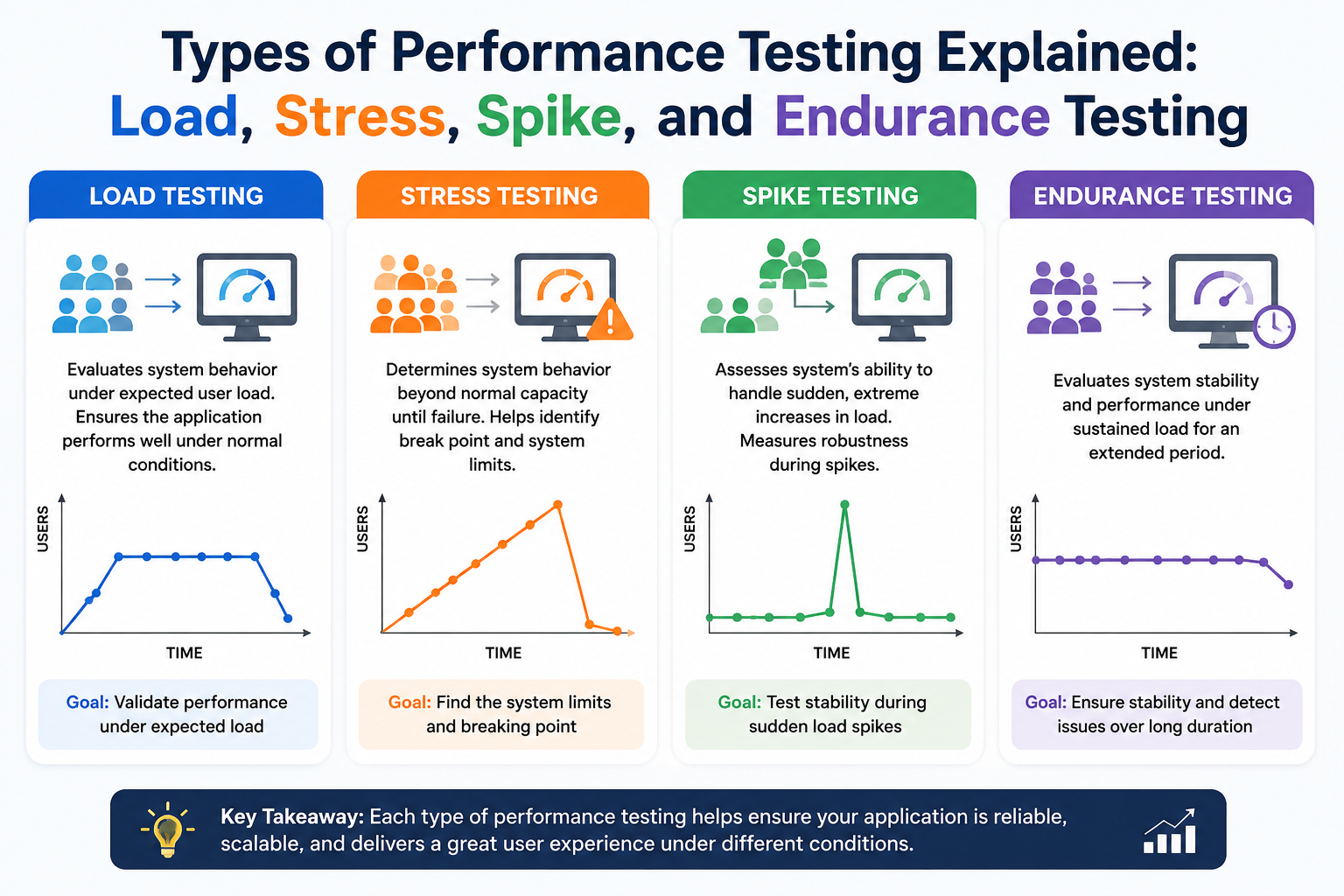
- Load Testing: Simulates expected user loads to measure system behavior.
- Stress Testing: Pushes the system beyond normal limits to identify breaking points.
- Endurance Testing (Soak Testing): Tests the system under sustained load over extended periods to detect memory leaks or performance degradation.
- Spike Testing: Evaluates behavior during sudden, short bursts of high traffic.
- Volume Testing: Assesses performance with large volumes of data.
Metrics Measured in Performance Testing
- Response Time
- Throughput (transactions per second)
- Error Rate
- Resource Utilization (CPU, Memory, Disk I/O, Network)
- Latency
- Concurrent Users Supported
Performance testing is critical across industries. For example, an online banking app must load account details within 2 seconds even during month-end processing. E-commerce sites need fast checkout processes during sales events.
At Sdettech, our performance testing engagements often begin with baseline measurements under realistic conditions. We use industry-standard protocols to simulate real user journeys, ensuring results are actionable and aligned with business SLAs.
What is Scalability Testing?
Scalability Testing is a subset of performance testing that specifically evaluates a system's ability to scale up or scale out efficiently as demand increases. It focuses on how well the application handles growing workloads—whether through additional users, data volume, or transaction complexity—without compromising performance.
While performance testing checks "how well does it perform now?", scalability testing asks "how well will it perform as we grow?"
Key Aspects of Scalability Testing
- Vertical Scaling (Scaling Up): Adding more resources (CPU, RAM) to a single server.
- Horizontal Scaling (Scaling Out): Adding more servers or instances (common in cloud-native architectures).
- Database Scalability: Handling increasing data volumes and query loads.
- Architectural Scalability: Evaluating microservices, load balancers, caching layers, and distributed systems.
Important Metrics in Scalability Testing
- Scaling Factor (performance change relative to resource increase)
- Breakpoint Analysis
- Cost Efficiency of Scaling
- Failover and Recovery Time
- Elasticity (ability to scale dynamically in cloud environments)
Scalability testing is particularly vital for startups planning rapid growth, SaaS platforms expecting seasonal spikes, and enterprises migrating to cloud infrastructure.
Sdettech has helped numerous clients transition from monolithic to scalable microservices architectures by identifying scalability bottlenecks early through rigorous testing.
Performance Testing vs Scalability Testing: Key Differences
Understanding the distinction is crucial for effective test strategy planning. Here's a detailed comparison:
| Aspect |
Performance Testing |
Scalability Testing |
| Primary Focus |
Speed, responsiveness, stability under load |
Ability to handle increased load/growth |
| Scope |
Broader (includes load, stress, endurance) |
Narrower, focused on growth potential |
| Load Pattern |
Expected or slightly above normal loads |
Gradually increasing or significantly higher loads |
| Goal |
Meet current performance benchmarks |
Determine future capacity and scaling strategy |
| When Performed |
Throughout development and before release |
During capacity planning and architecture reviews |
| Key Question |
"Does it perform well under current conditions?" |
"How will it perform as demand grows?" |
| Resource Analysis |
Current utilization |
Efficiency of adding resources |
| Outcome |
Optimization recommendations for speed |
Scaling recommendations (horizontal/vertical) |
Detailed Breakdown of Differences
1. Objectives Performance Testing aims to validate that the system meets specific performance requirements (e.g., page load time < 3 seconds). Scalability Testing determines the upper limits and optimal scaling strategies.
2. Methodology In performance testing, testers simulate realistic user scenarios using tools to measure response times and identify bottlenecks. Scalability testing involves incremental load increases, often with infrastructure modifications, to observe how performance metrics change with added resources.
3. Timing in SDLC Performance testing is typically integrated into CI/CD pipelines and conducted in later stages. Scalability testing often occurs during architectural design phases or before major releases involving capacity planning.
4. Tools and Environment Both use similar tools, but scalability testing may require cloud environments (AWS, Azure, GCP) with auto-scaling groups for realistic results.
5. Risk Addressed Performance testing mitigates risks of poor user experience and SLA violations. Scalability testing addresses risks of system failure during growth periods, such as viral marketing campaigns or business expansions.
At Sdettech, we often combine both approaches in our "Performance and Capacity Assurance" framework. This integrated method ensures applications not only perform well today but are future-proofed for tomorrow's demands.
Why Both Matter: Real-World Implications
Consider a popular e-commerce platform during Black Friday sales. Performance testing ensures the website loads quickly and processes transactions smoothly under anticipated traffic. However, without proper scalability testing, a sudden traffic surge could overwhelm servers, causing downtime and lost sales.
Another example is a fintech application handling millions of transactions daily. Performance testing validates transaction speed and security checks. Scalability testing ensures the system can handle increased user registration and trading volume as the company expands.
Failure to differentiate and implement both can lead to:
- Over-provisioning of infrastructure (wasted costs)
- Under-provisioning leading to outages
- Poor user retention
- Missed growth opportunities
Best Practices for Effective Testing
For Performance Testing:
- Define clear performance benchmarks based on user expectations and competitor analysis.
- Use realistic test data and user behavior patterns.
- Test on production-like environments.
- Monitor both frontend and backend metrics.
- Implement continuous performance testing in CI/CD.
For Scalability Testing:
- Start with baseline performance measurements.
- Incrementally increase load and resources.
- Test different scaling strategies (vertical vs horizontal).
- Include failure scenarios and recovery testing.
- Measure cost implications of scaling.
Common Tools
Popular Performance Testing Tools:
- JMeter
- LoadRunner
- Gatling
- k6
- Apache Benchmark
Scalability-Focused Tools and Platforms:
- Locust
- BlazeMeter
- Cloud-based solutions (AWS Load Testing, Azure Load Testing)
- Kubernetes-based scaling tests
Sdettech recommends a tool-agnostic approach tailored to your technology stack. Our experts have extensive experience with open-source and commercial tools, ensuring cost-effective yet comprehensive coverage.
Implementing a Combined Strategy: Sdettech's Approach
At Sdettech, we advocate for an integrated performance and scalability testing strategy:
- Discovery Phase: Understand business goals, expected growth, and current bottlenecks.
- Baseline Performance Testing: Establish current system capabilities.
- Scalability Assessment: Model future scenarios and test scaling options.
- Optimization: Provide actionable recommendations for code, architecture, and infrastructure.
- Continuous Monitoring: Implement APM (Application Performance Monitoring) tools for ongoing visibility.
Our clients have reported up to 40% improvement in response times and successful handling of 5x traffic growth after implementing our recommendations.
Case Study: E-commerce Platform Transformation
A mid-sized e-commerce client approached Sdettech facing slow page loads during promotional campaigns. Our performance testing revealed database query inefficiencies and unoptimized images. After fixes, average response time dropped by 65%.
Subsequent scalability testing identified limitations in their monolithic architecture. We recommended and validated a move toward microservices with auto-scaling. The result? The platform successfully handled record traffic during the next major sale with zero downtime.
Challenges and How to Overcome Them
Common Challenges in Performance Testing:
- Creating realistic test environments
- Test data management
- Tool selection for complex applications
Challenges in Scalability Testing:
- High infrastructure costs for testing
- Complexity in distributed systems
- Predicting future load accurately
Solutions:
- Leverage cloud environments for on-demand resources
- Use service virtualization
- Implement shift-left testing practices
- Combine synthetic monitoring with real-user monitoring (RUM)
Future Trends
The landscape is evolving with:
- AI-powered performance predictions
- Shift to cloud-native and serverless architectures
- Increased focus on API performance
- Integration of performance testing in DevOps pipelines
- Sustainability considerations (energy-efficient scaling)
Sdettech stays ahead by incorporating these trends into our testing methodologies, helping clients build modern, efficient systems.
Conclusion
While performance testing ensures your application delivers excellent user experience under current conditions, scalability testing prepares it for future success and growth. Both are indispensable components of a mature quality assurance strategy.
Understanding the difference allows organizations to allocate resources effectively, mitigate risks, and deliver superior digital products. Whether you're building the next big SaaS platform or optimizing legacy enterprise systems, a balanced approach to performance and scalability testing is key.
At Sdettech, we partner with businesses to deliver comprehensive testing solutions that drive performance excellence and sustainable growth. Our team of certified professionals uses proven methodologies and cutting-edge tools to ensure your applications are fast, reliable, and ready to scale.


 Search in Classifieds
 Search in Groups
 Search in Polls
 Search in Members
 Search in Members
 Search in News
 Search in Businesses
 Search in Contests
 Search in Events
 Search in Music Albums
 Search in Music Songs
 Search in Quotes
 Search in Site Team



)


Share this page with your family and friends.