Albert Einstein is one of the most famous scientists in history, and his name has become almost synonymous with extraordinary intelligence. His theories transformed modern physics, and his reputation as a genius has led millions of people to wonder about his intelligence in numerical terms.
One question appears repeatedly online: what is Einstein's IQ, and how does it compare with the average person's IQ?
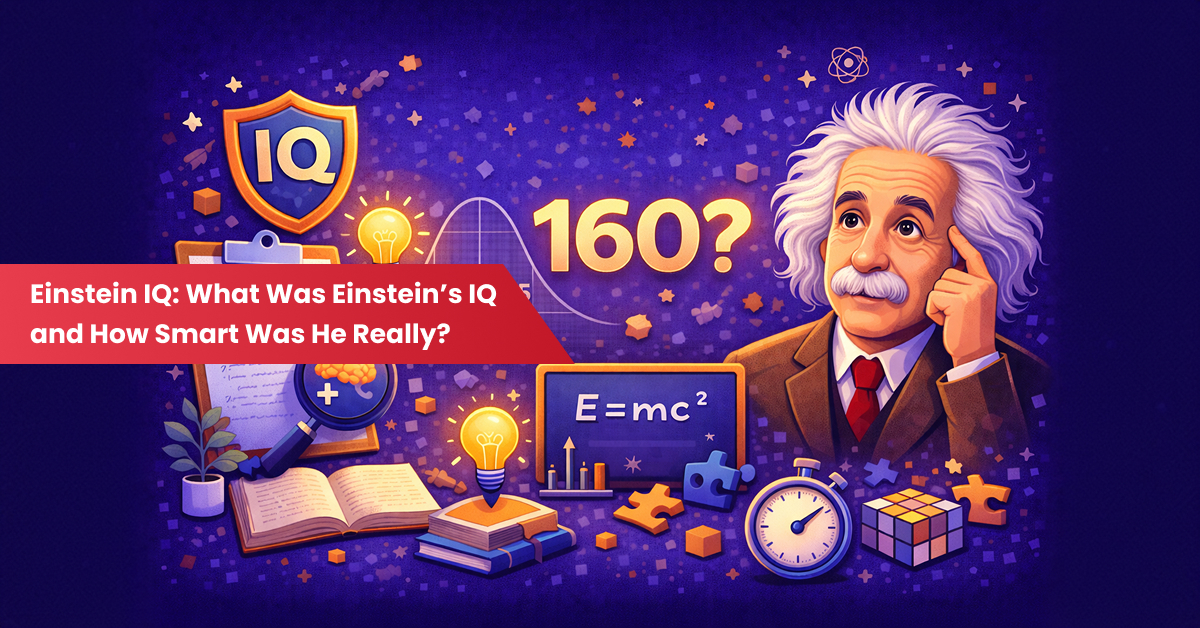
The commonly quoted answer is that Einstein had an IQ of around 160. However, there is an important problem with that figure. There is no verified record showing that Einstein ever took a standardized IQ test or received an official IQ score. The number 160 is a retrospective estimate, not a documented test result.
This distinction matters because an IQ score is meaningful only when it comes from a properly administered and standardized assessment. While Einstein's intellectual achievements clearly demonstrate exceptional ability, assigning him an exact IQ number is speculative.
What Is Einstein's IQ?
So, what is Einstein's IQ according to the historical evidence?
The most accurate answer is that nobody knows.
The figure of 160 is frequently repeated in articles, social media posts, quizzes, and online IQ websites. Some sources have even attributed higher numbers to Einstein. However, there is no publicly verified test report establishing that he earned an IQ of 160, 180, 190, or any other specific number.
Einstein was born in 1879 and became internationally famous during the early twentieth century. Although intelligence testing existed during his lifetime, there is no reliable public record showing that he completed a standardized IQ assessment that produced the score now commonly attributed to him.
Therefore, saying "Einstein had an IQ of 160" is more accurately described as saying "Einstein is often estimated to have had an IQ of about 160."
That may seem like a small distinction, but it is important when discussing historical figures.
Why Is 160 So Commonly Associated With Einstein?
The number 160 has become closely connected with Einstein because writers and popular culture have attempted to translate his extraordinary achievements into a modern intelligence score.
Einstein's contributions to physics were revolutionary. His work on special relativity, general relativity, the photoelectric effect, and other areas changed scientific understanding. His achievements make it reasonable to describe him as exceptionally intellectually capable.
However, achievement and IQ are not identical.
An IQ test measures particular cognitive abilities under specific testing conditions. Scientific achievement involves many additional qualities, including creativity, persistence, specialized knowledge, curiosity, imagination, mathematical ability, and the capacity to develop original ideas.
The 160 figure therefore should not be viewed as a measurement that Einstein actually received.
How Does an IQ of 160 Compare With Average Intelligence?
To understand why an estimated IQ of 160 sounds so extraordinary, it helps to understand the modern IQ scale.
Most contemporary IQ tests are designed around an average score of 100, with a standard deviation of 15. This means that a large proportion of people score relatively close to 100.
An IQ of 115 is approximately one standard deviation above average. An IQ of 130 is approximately two standard deviations above average. An IQ of 145 is approximately three standard deviations above average.
An IQ of 160 would be about four standard deviations above the mean on such a scale.
That represents an extremely rare level of performance.
However, there is an important technical limitation. At very high levels, IQ scores become increasingly difficult to measure precisely. Standardized tests have finite numbers of questions and may not distinguish reliably between people at the extreme upper end of the distribution.
This is another reason why assigning Einstein a precise number such as 160 should be approached cautiously.
Average IQ Compared With Einstein's Estimated IQ
If we temporarily use the popular estimate of 160, the difference between Einstein and the average person appears enormous.
The average IQ is conventionally set at 100. An estimated IQ of 160 would therefore be 60 points above the average.
On a scale with a standard deviation of 15, that difference represents four standard deviations.
But it is important not to interpret this as meaning Einstein was simply "60 percent smarter" than the average person. IQ is not a percentage measurement.
An IQ of 120 does not mean a person is 20 percent more intelligent than someone with an IQ of 100. Similarly, an IQ of 160 does not mean that a person has 60 percent more intelligence than someone with an IQ of 100.
IQ scores are standardized measurements of cognitive performance, not percentages of human intelligence.
What Made Einstein So Intelligent?
Although his IQ cannot be confirmed, Einstein's intellectual accomplishments are well documented.
One of his most important strengths was his ability to think about physical problems in unusual ways. He was famous for using thought experiments to explore complicated concepts.
Rather than relying exclusively on conventional approaches, Einstein often imagined hypothetical situations and considered what they would imply about the laws of physics.
This type of conceptual thinking was extremely important to his scientific work.
His ability to connect mathematics, physics, observation, and abstract reasoning allowed him to develop theories that challenged established assumptions.
His achievements therefore provide strong evidence of exceptional intellectual ability even though they cannot be converted reliably into an IQ score.
Einstein's Intelligence Was More Than a Number
The fascination with Einstein's IQ can sometimes obscure what actually made him remarkable.
A high IQ score does not automatically make someone a great scientist. Scientific achievement requires more than rapid reasoning or strong performance on standardized cognitive tasks.
Einstein's accomplishments also depended on creativity, persistence, intellectual independence, curiosity, and an extraordinary ability to work with abstract concepts.
He was willing to question assumptions that other scientists accepted.
This quality is difficult to capture with a conventional IQ test.
An intelligence test might ask someone to identify a pattern, solve a logical problem, or manipulate information mentally. Einstein's greatest contributions involved creating new frameworks for understanding physical reality.
Those are related abilities, but they are not identical.
Did Einstein Really Have an IQ of 160?
There is no reliable evidence that allows us to say this with certainty.
The responsible answer is that Einstein's IQ is unknown. The often repeated estimate of 160 should be treated as an informal retrospective estimate rather than an official score.
Some online sources have attributed even higher scores to him, including numbers approaching 190 or above. These claims are even less useful because they are not supported by a documented standardized test result.
The wide range of estimates itself demonstrates the problem. If different sources can assign dramatically different numbers to the same historical person, those numbers should not be treated as established facts.
Could Einstein Have Scored 160 on a Modern IQ Test?
It is possible, but there is no way to know.
A modern IQ assessment would measure Einstein using questions and norms that were not necessarily available to him during his lifetime. His performance could have varied across different cognitive areas.
For example, someone might have exceptional abstract reasoning but perform less strongly on processing speed or certain verbal tasks. An overall IQ score combines performance across multiple areas depending on the specific assessment.
Furthermore, historical reconstruction cannot reproduce the actual testing environment.
We do not know how Einstein would have responded to modern test instructions, time limits, unfamiliar question formats, or standardized testing conditions.
Consequently, attempting to calculate his exact modern IQ is more speculative than scientific.
Einstein Compared With the Average Person
If the popular estimate of 160 is used purely for illustration, Einstein would be dramatically above the average IQ of 100.
The comparison would look roughly like this:
Average IQ: 100
One standard deviation above average: 115
Two standard deviations above average: 130
Three standard deviations above average: 145
Popular estimate for Einstein: 160
This comparison shows why the number has become associated with exceptional intelligence.
However, these figures should not be interpreted as a verified ranking of Einstein against everyone else. His 160 score is not documented, while the other values describe the structure of modern IQ scales.
Why IQ Scores Should Not Define Intelligence
The fascination with Einstein's IQ also raises a broader question about what intelligence actually means.
IQ tests can provide useful information about certain cognitive abilities. They can measure reasoning, working memory, processing speed, verbal abilities, and other forms of mental performance.
But intelligence is broader than a standardized score.
Creativity, curiosity, practical problem solving, emotional understanding, communication, adaptability, knowledge, motivation, and persistence can all contribute to achievement.
Someone with an average IQ can accomplish remarkable things through dedication, education, creativity, and opportunity. Likewise, someone with a very high IQ is not automatically successful in every area of life.
Einstein's story illustrates this point particularly well. His legacy is not important because someone calculated a hypothetical number for him. It is important because of the ideas he developed and the lasting impact those ideas had on science.
What Can We Learn From Einstein's Intelligence?
Rather than focusing exclusively on what is einstein's iq it may be more useful to consider the intellectual qualities demonstrated by his work.
Einstein showed the importance of asking fundamental questions. He challenged assumptions, explored hypothetical situations, developed mathematical theories, and remained curious about how the universe worked.
These qualities can be valuable regardless of someone's IQ score.
Students and aspiring scientists do not need an IQ of 160 to develop strong reasoning abilities. Learning how to question assumptions, solve problems creatively, understand difficult concepts, and persist through challenges can be far more useful than trying to reach a particular number.
Final Thoughts
So, what is Einstein's IQ?
The honest answer is that Einstein's actual IQ is unknown. There is no verified record of him receiving a standardized IQ score. The frequently quoted figure of 160 is a retrospective estimate that has become popular over time, not a documented result from an IQ test.
If the estimate of 160 were accurate, it would place him extraordinarily far above the conventional IQ average of 100. However, there is no scientific basis for claiming that 160 was Einstein's actual score.
What we do know is much more significant. Einstein demonstrated extraordinary intellectual ability through his scientific achievements, originality, mathematical reasoning, conceptual thinking, and willingness to challenge established ideas.
His legacy reminds us that intelligence cannot be reduced completely to a single number. An IQ score can measure certain cognitive abilities, but groundbreaking achievement also depends on creativity, curiosity, knowledge, persistence, and the courage to think differently.
Einstein's exact IQ may remain a mystery, but his intellectual impact is beyond dispute. His work changed our understanding of space, time, gravity, light, and the universe, which is ultimately a much more meaningful measure of his extraordinary mind than any estimated number.


 Search in Classifieds
 Search in Groups
 Search in Polls
 Search in Members
 Search in Members
 Search in News
 Search in Businesses
 Search in Contests
 Search in Events
 Search in Music Albums
 Search in Music Songs
 Search in Quotes
 Search in Site Team




Share this page with your family and friends.