An unwanted car can become a surprisingly difficult problem when it stops being useful.
Perhaps it has failed its MOT, suffered accident damage, developed a major mechanical fault or simply spent too long sitting unused on the driveway. In these situations, owners often ask whether they should repair the vehicle, sell it privately or arrange for it to be scrapped.
There is no single answer for every vehicle. The right option depends on the condition of the car, expected repair costs, resale value and how practical it is to keep the vehicle.
For owners who are considering disposal, a Scrap My Car UK service can provide a starting point for finding out what the vehicle may be worth.
When Does an Old Car Become Uneconomical to Repair?
Age alone does not determine whether a vehicle should be repaired.
Some older vehicles remain reliable and inexpensive to maintain, while a newer vehicle can develop a major problem that makes repair expensive.
The more useful question is whether the expected cost of keeping the car is reasonable compared with its current value and future usefulness.
Consider the following:
- Estimated repair bill
- Current market value
- Previous repair costs
- Expected future maintenance
- MOT requirements
- Tyre condition
- Insurance
- Vehicle tax
- Reliability
- Availability of replacement parts
If several major expenses are appearing at once, obtaining a scrap valuation can help you understand another option.
What If the Car Has Failed Its MOT?
A failed MOT is not automatically a reason to scrap a car.
Look at the reasons for the failure.
A vehicle may fail because of relatively straightforward issues such as worn tyres, bulbs, brakes or suspension components. In other cases, the problem may involve corrosion, engine faults or other expensive repairs.
Getting a repair estimate is useful.
If the repair cost is modest and the vehicle is otherwise reliable, repairing it may make sense for the owner.
If the repair bill is substantial and the vehicle has several other problems, selling it for scrap may be worth considering.
What If the Engine Has Failed?
An engine failure can dramatically change the economics of an older vehicle.
A replacement engine or major engine repair can be expensive, particularly when labour is included.
Before spending money on repairs, compare the estimated repair cost with:
- The vehicle's current value
- The cost of a replacement vehicle
- Other repairs likely to be needed
- The vehicle's age
- Its mileage
- Its previous maintenance history
A failed engine does not necessarily make the vehicle worthless.
The rest of the vehicle can still contain usable components and recyclable materials.
What If the Gearbox Has Failed?
Gearbox repairs can also be expensive.
Manual and automatic transmission problems can involve anything from relatively minor repairs to complete gearbox replacement.
If a vehicle is older and already requires significant mechanical work, adding a gearbox repair to other upcoming expenses can change the overall calculation.
For cars with major transmission problems, a scrap valuation can provide another figure to compare with the repair estimate.
You can also learn more about the specific issue in this guide to scrapping a car without a gearbox.
Can a Damaged Car Be Scrapped?
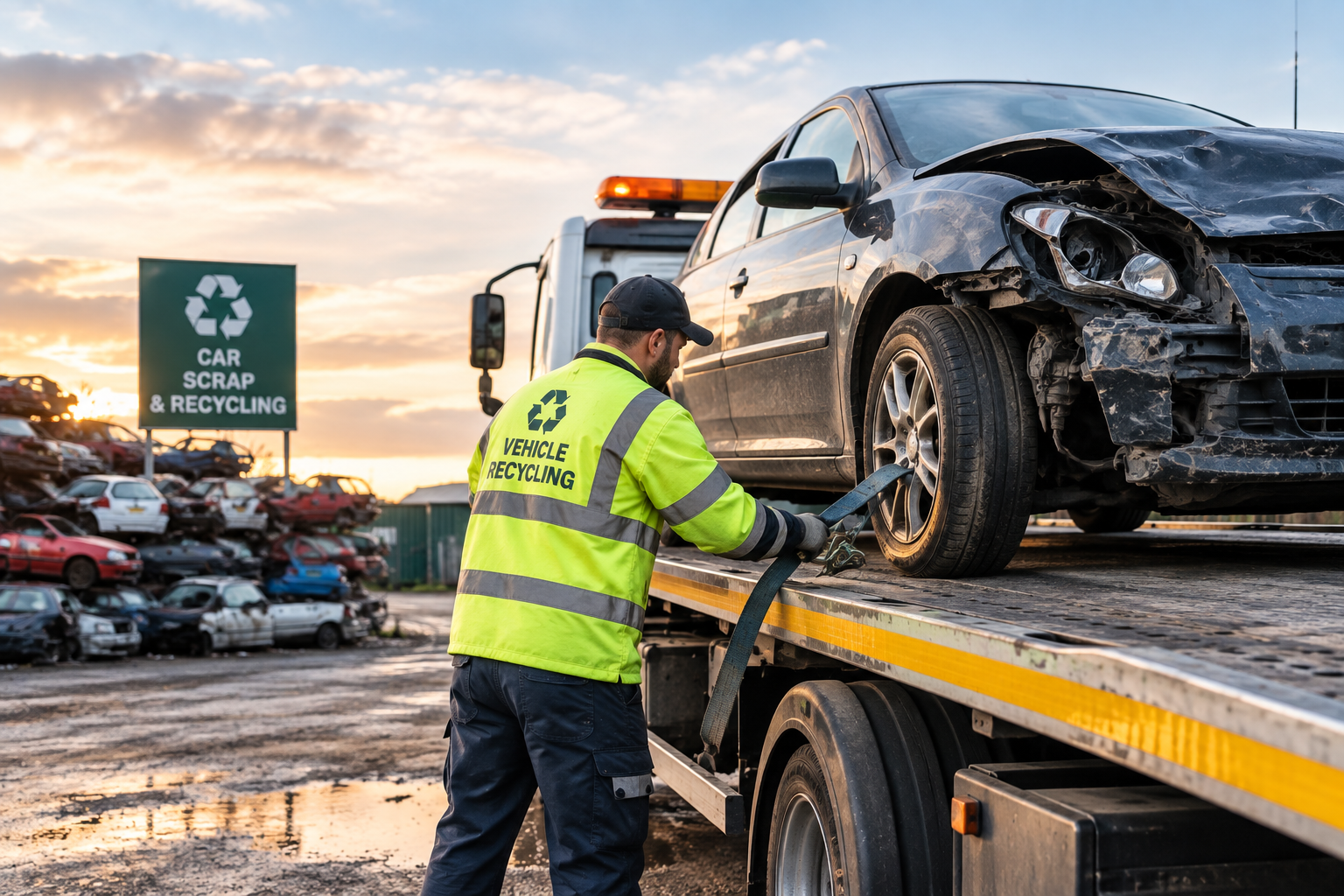
Yes, accident-damaged cars can potentially be scrapped.
The important point is to provide an accurate description of the damage before arranging collection.
For example, tell the provider if:
- The vehicle has severe front-end damage
- The wheels are damaged
- The car cannot roll
- The airbags have deployed
- The engine does not start
- Major components are missing
- The vehicle is difficult to access
This information can help the collection provider determine the appropriate arrangements.
What About a Car With Serious Rust?
Rust is common on older vehicles, but its significance depends on where it occurs and how severe it is.
Surface corrosion may be relatively straightforward to address.
Structural corrosion can be much more serious, particularly if it affects important parts of the vehicle's structure.
If the car requires extensive bodywork and has other age-related problems, it may be worth comparing the repair cost with the vehicle's scrap value.
Can You Scrap a Car That Has Been Sitting for Years?
A vehicle that has been unused for several years may have developed more problems than the owner realises.
Tyres can deteriorate, batteries can fail, brakes can seize and fluids may need attention. A car that was perfectly usable when parked may no longer be economical to return to the road.
Before spending money getting a long-term parked vehicle roadworthy again, calculate the likely total cost.
This can include recovery, servicing, MOT work, tyres, brakes, battery and other repairs.
If the figure is high, scrapping could be a practical alternative.
What If the Car Does Not Start?
A non-running vehicle can still be collected for scrap.
However, always mention that the car is a non-runner when requesting a quote.
The collection vehicle may need appropriate loading equipment, particularly if the car cannot roll or steer.
Tell the provider if the vehicle is:
- Completely immobile
- Able to roll but not start
- Missing wheels
- Parked on private property
- Located in a restricted-access area
Clear information helps avoid problems on collection day.
Should You Sell Privately Instead?
A private sale may be suitable for a roadworthy vehicle with reasonable resale value.
However, selling a damaged or non-running vehicle privately can take considerably more effort.
You may need to create an advertisement, answer messages, negotiate with buyers and arrange inspections.
There is also no guarantee that interested buyers will actually complete the purchase.
For a vehicle with major faults, a direct scrap valuation can provide a simpler comparison.
What Happens to the Vehicle After Collection?
When a vehicle is completely scrapped through an authorised treatment facility, it goes through an appropriate end-of-life vehicle process.
GOV.UK states that vehicles should be taken to an authorised treatment facility and that it is illegal to scrap them elsewhere.
The facility can determine whether the vehicle should be completely scrapped or whether it can be repaired and sold.
Where a qualifying vehicle is completely scrapped, a Certificate of Destruction is issued, normally within seven days.
This documentation is important because it confirms that the vehicle has entered the destruction process.
What Should You Do With the V5C?
The V5C should be dealt with according to current DVLA instructions.
GOV.UK advises owners to give the V5C to the ATF while keeping the yellow “sell, transfer or part-exchange” section, and to tell DVLA that the vehicle has been taken to an ATF.
Keep any documentation you receive after collection.
How Can You Decide?
A simple comparison can help.
| Question |
Repair |
Scrap |
| Is the vehicle worth repairing? |
Consider repair estimate |
Obtain scrap valuation |
| Does it have several major faults? |
Calculate future costs |
Consider total disposal value |
| Does it still have reasonable resale value? |
Compare with repair costs |
Compare with scrap value |
| Is it a non-runner? |
Consider recovery and repairs |
Ask about collection |
| Has it suffered major damage? |
Obtain professional estimate |
Request a scrap valuation |
The table is not a recommendation for one option. It simply shows the information worth considering before making a decision.
Final Thoughts
An old, damaged or non-running vehicle does not automatically have to be repaired or sold privately.
The practical choice depends on the vehicle's condition, repair costs, current value and future reliability.
Obtaining a scrap valuation is one way to understand the alternative before committing to an expensive repair.
For many owners, the most useful first step is simply to find out what the vehicle is worth in its current condition and then compare that figure with the cost of keeping it on the road.


 Search in Classifieds
 Search in Groups
 Search in Polls
 Search in Members
 Search in Members
 Search in News
 Search in Businesses
 Search in Contests
 Search in Events
 Search in Music Albums
 Search in Music Songs
 Search in Quotes
 Search in Site Team



Share this page with your family and friends.