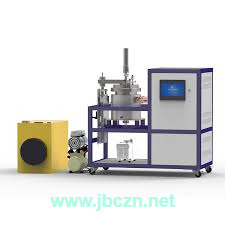
Large-area diamond coating has attracted attention in fields where surface hardness, thermal performance, chemical stability, and wear resistance are important. As applications expand from laboratory research toward industrial components, equipment designers face the challenge of maintaining stable deposition conditions across a larger substrate surface.MPCVD diamond deposition coating equipment therefore requires careful consideration of microwave energy, plasma distribution, gas flow, chamber structure, substrate temperature, and process control. With the technical background presented by JBCZN, can this type of equipment support large-area diamond coating?
One of the central challenges in large-area deposition is maintaining a consistent plasma environment. Microwave plasma needs to remain sufficiently stable across the working region so that active chemical species can reach the substrate in a controlled manner. When the coated surface becomes larger, variations in plasma density may influence deposition behavior from one area to another. Chamber geometry, microwave coupling, and operating conditions therefore become closely connected during equipment development.
Gas distribution is another important factor. Diamond deposition commonly relies on a controlled mixture of process gases, and the distribution of these gases across the substrate can influence film formation. A chamber designed for a larger working area needs a suitable gas inlet arrangement so that reactants can reach different positions without creating significant concentration differences. Flow simulation and practical testing can help engineers evaluate how gas movement changes inside the chamber.
Temperature control also deserves careful attention. Substrate temperature can influence the chemical reactions taking place during diamond growth, as well as the resulting film structure and deposition behavior. On a small substrate, maintaining a relatively consistent temperature can be manageable, while a larger surface creates additional thermal management requirements. Heating arrangements, substrate holders, chamber geometry, and cooling structures can therefore become important parts of the equipment design.
Substrate positioning can affect the final coating as well. If different sections of a large workpiece are exposed to different plasma conditions, variations in film thickness or quality may appear. A carefully designed holder can help maintain a suitable relationship between the substrate and plasma region. Depending on the application, rotation or other positioning methods may also be considered to create a more balanced deposition environment.
Microwave power is another variable that needs precise control. The plasma must receive sufficient energy to sustain the desired reaction environment, while unstable operating conditions can affect the deposition process. For large-area systems, the relationship between microwave source characteristics, chamber dimensions, pressure, and gas composition becomes increasingly important because changes in one parameter can influence the others.
Chamber design has a direct connection with scalability. A chamber intended for research samples does not necessarily require the same internal arrangement as a system designed for larger industrial components. Engineers may need to examine the available working space, microwave coupling structure, gas inlet layout, substrate support, viewing ports, vacuum components, and maintenance access before selecting a suitable configuration.
Vacuum performance also plays an important role. A stable vacuum environment provides a controlled space for the plasma process, while leakage, contamination, or unstable pressure can interfere with production conditions. Pumps, valves, pressure sensors, sealing structures, and control software all contribute to the overall vacuum system. Regular maintenance can help keep these components operating within their intended conditions.
Process monitoring can make large-area deposition easier to manage. Temperature sensors, pressure monitoring, microwave power feedback, gas-flow measurement, and other parameters can provide operators with useful information during production. Automated control systems can respond to selected process changes and help maintain established operating conditions during a coating cycle.
Large-area diamond coating may be relevant to various technical fields. Diamond films can be considered for heat-spreading components, cutting tools, optical elements, electronic applications, protective surfaces, and research materials. Each application can involve different substrate materials, film thickness requirements, surface geometry, and production targets, so equipment configuration needs to correspond with the intended use.
Surface preparation should not be ignored when considering coating quality. Before deposition, the substrate may require cleaning, polishing, seeding, etching, or other preparation steps depending on its material and the selected process. Contamination or an unsuitable surface condition can affect nucleation and film adhesion. A complete production workflow therefore involves preparation as well as the deposition stage itself.
Uniformity is particularly important when a large component needs to function as one integrated surface. Variations in thickness, grain structure, surface morphology, or composition may influence the performance of the finished part. Equipment development can therefore involve repeated process testing to identify suitable combinations of pressure, gas composition, microwave power, substrate temperature, and deposition time.
Automation can also support repeatable operation. Manual adjustments may be appropriate during experimental development, while production environments often require clearly defined process parameters. A control interface can allow operators to monitor key conditions and record production information. Such data can provide useful references when a process needs to be reproduced or adjusted for another substrate size.
Equipment flexibility can be useful for manufacturers serving different customers. A system may need to accommodate various substrate dimensions or shapes rather than being limited to one fixed workpiece. Modular chamber structures, adjustable holders, configurable gas systems, and adaptable process controls can provide practical options when different coating projects are involved.
For companies researching coating technologies, the supplier's wider equipment portfolio can also provide useful information about its engineering capabilities. JBCZN, operated by GOLD BLINGKING Intelligent Technology, presents industrial coating equipment and related solutions for different surface treatment requirements. Businesses can review the equipment information available through https://www.jbczn.net/ when evaluating potential technologies, configurations, and supplier capabilities.
Large-area diamond coating remains closely connected with process stability and equipment engineering. MPCVD Diamond Deposition Coating Equipment needs coordinated control of plasma distribution, gas flow, thermal management, microwave coupling, vacuum conditions, substrate positioning, and automation. Careful coordination of these elements can provide a foundation for coating larger surfaces while maintaining controlled deposition conditions across the working area


 Search in Classifieds
 Search in Groups
 Search in Polls
 Search in Members
 Search in Members
 Search in News
 Search in Businesses
 Search in Contests
 Search in Events
 Search in Music Albums
 Search in Music Songs
 Search in Quotes
 Search in Site Team



Share this page with your family and friends.