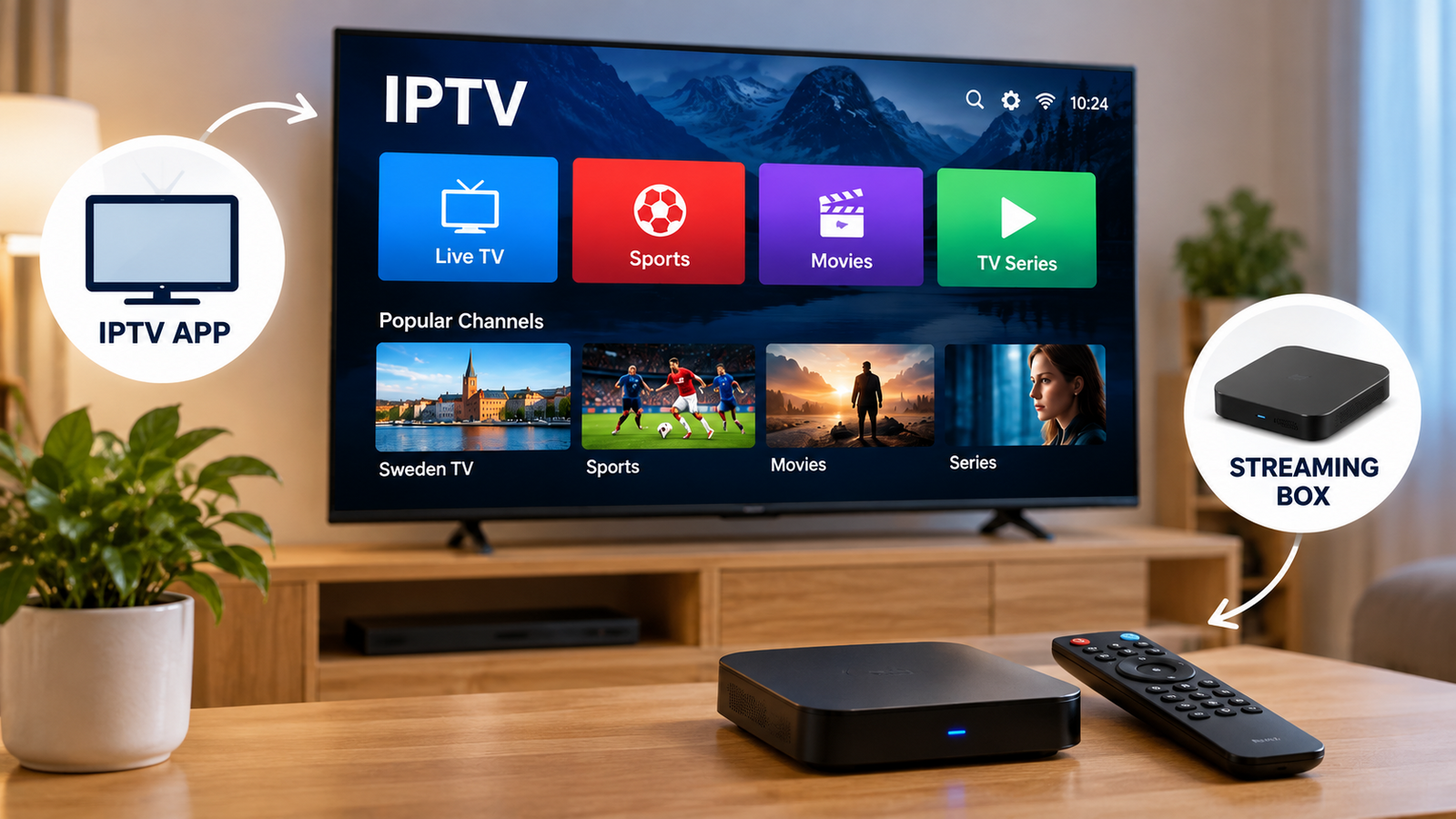
Watching television through the internet can be simple, but choosing the right device setup is an important part of the experience. Some viewers prefer installing an IPTV app directly on a Smart TV, while others use a dedicated streaming box connected through HDMI.
Both approaches can work well. The better option depends on the television, available applications, preferred features, network connection, and how much control the viewer wants over the streaming experience.
For households in Sweden, understanding the differences between IPTV apps and external streaming devices can make it easier to choose a practical setup.
How IPTV Apps Work on Smart TVs
Many modern Smart TVs include an application store where compatible IPTV players can be installed.
The player acts as the interface between the television and the IPTV subscription. Depending on the application and service, users may enter a playlist URL, portal information, or account credentials supplied by their provider.
The main advantage is simplicity. Everything happens directly on the television, so there is no separate box taking up space beside the screen.
When a Smart TV App Makes Sense
A direct Smart TV setup is particularly convenient for people who want fewer devices and cables.
Modern Samsung, LG, Android TV, and other Smart TV platforms may offer compatible IPTV players, although application availability varies by model, operating system, and region.
Before selecting a player, users should confirm that it supports both their television and the connection method used by their IPTV service.
What Is an IPTV Streaming Box?
A streaming box is an external device connected to the television, usually through HDMI.
Depending on the device, it may run Android TV or another operating system designed for television applications. Dedicated IPTV boxes can also provide their own interfaces and remote-control features.
Instead of relying on the television's built-in software, the external device handles most of the streaming process.
This can be useful when a Smart TV has limited application support or older hardware.
Smart TV App vs Streaming Box
There is no universal winner because the two setups serve different needs.
A Smart TV application provides convenience. Users can turn on the television and open the player without switching HDMI inputs or managing additional hardware.
A streaming box, however, can provide greater flexibility. Newer external devices may support a wider range of applications and receive software updates independently from the television.
This can extend the useful life of an older TV that still has a good screen but outdated smart features.
Consider the Age of Your Television
Television age can influence IPTV performance.
Older Smart TVs may have slower processors, limited storage, or application stores that no longer receive the latest versions of popular streaming software.
If applications frequently freeze, load slowly, or are unavailable entirely, replacing the television is not always necessary. A compatible external streaming device may provide access to newer software while continuing to use the existing screen.
Newer televisions with responsive operating systems may not need additional hardware at all.
Think About IPTV Player Availability
The subscription and the player are separate parts of many IPTV setups.
A provider supplies access to content, while the IPTV player organizes and displays the channels, program information, films, or series.
Different devices support different players. Some applications are designed mainly for Android-based hardware, while others are available for specific Smart TV operating systems.
Swedish viewers researching subscription choices, setup information, devices, and IPTV viewing options can also explore Rapid IPTV Sweden while comparing the type of setup that best matches their equipment.
Look at Navigation and Remote Controls
A technically capable device is not always enjoyable to use if navigation feels complicated.
The remote control should make everyday actions easy, including opening categories, changing channels, searching for content, adjusting subtitles, and returning to recently watched programming.
Dedicated streaming boxes may provide remotes designed around media navigation, while Smart TV applications use the television's existing remote.
The preferable option depends largely on personal habits.
Check Network Connectivity
Both Smart TV apps and streaming boxes require a stable internet connection.
Wi-Fi is convenient, especially when the router and television are located close together. However, signal strength can decrease because of distance, walls, interference, and other connected devices.
Ethernet can provide a more consistent connection when both the television or streaming box and router support it.
Before blaming an IPTV application for buffering, users should check whether the home network is stable.
Consider How Many Apps You Use
An external device can become more useful when the television is used for several types of streaming.
A modern streaming box may allow users to keep IPTV players, video services, media players, and other entertainment applications together in one interface.
For viewers who use only one or two applications, the built-in Smart TV platform may already provide everything required.
The important point is to avoid adding hardware unless it solves a genuine limitation.
Important Features to Compare
Whether choosing an application or an external box, viewers should consider the features they actually use. Useful capabilities can include:
-
Electronic program guide support
-
Favorites and channel organization
-
Search functions
-
Subtitle and audio options
-
Parental controls
-
Video-on-demand navigation
-
Hardware decoding support
-
Playlist or portal compatibility
Not every viewer needs every feature, so a simpler application can sometimes provide a better experience than a complicated player with many advanced settings.
Keep Software Updated
Streaming applications and device operating systems should be kept reasonably up to date.
Updates may improve compatibility, fix technical problems, and address security issues.
Smart TV manufacturers eventually reduce software support for older models. External streaming devices can sometimes provide a practical alternative because they have their own update cycle.
However, external hardware also ages, so users should not assume that every streaming box will receive updates indefinitely.
What About Android TV Devices?
Android TV and similar platforms are popular because they provide access to a broad selection of streaming applications.
They can be built directly into a television or provided through an external box.
An Android-based setup may appeal to viewers who want more flexibility when choosing IPTV players, but application compatibility should still be checked before purchasing a device.
Downloading software from trusted application stores is generally preferable to installing unknown files from unofficial sources.
When a Dedicated IPTV Box May Be Better
Some viewers prefer hardware designed specifically around IPTV navigation.
Dedicated boxes may provide interfaces focused on live television, program guides, channel switching, and remote-control shortcuts.
They can be useful for people who want a television-like experience instead of navigating through a general-purpose app ecosystem.
The exact features vary between models, so buyers should evaluate hardware support and software compatibility rather than choosing solely based on brand or price.
When a Smart TV App Is Enough
A separate device is unnecessary when the existing television already performs well.
If the preferred IPTV player is available, menus respond quickly, video playback is stable, and the network connection works properly, a direct Smart TV setup can be the simplest solution.
Fewer devices also mean fewer cables, power adapters, remote controls, and settings to manage.
For many households, convenience is more valuable than having the largest possible selection of technical options.
Do You Need to Replace Your Current Setup?
Not necessarily.
If IPTV already works reliably on your existing device, there is little reason to change equipment simply because newer options exist.
Consider upgrading when there is a clear problem, such as unsupported applications, slow navigation, frequent crashes, limited software updates, or poor compatibility with the preferred IPTV player.
Solving a specific limitation usually leads to a better purchase decision than upgrading based on specifications alone.
Final Thoughts
Choosing between an IPTV app and a streaming box depends on the television, software support, network connection, and personal viewing habits.
A Smart TV application offers a clean and convenient setup with minimal equipment. An external streaming box can provide greater flexibility, newer software, and additional application choices, especially for older televisions.
Before buying new hardware, viewers should first check what their existing television can support. The best IPTV setup is not necessarily the most complicated one. It is the setup that provides reliable playback, straightforward navigation, and compatibility with the services and devices used at home.


 Search in Classifieds
 Search in Groups
 Search in Polls
 Search in Members
 Search in Members
 Search in News
 Search in Businesses
 Search in Contests
 Search in Events
 Search in Music Albums
 Search in Music Songs
 Search in Quotes
 Search in Site Team


Share this page with your family and friends.