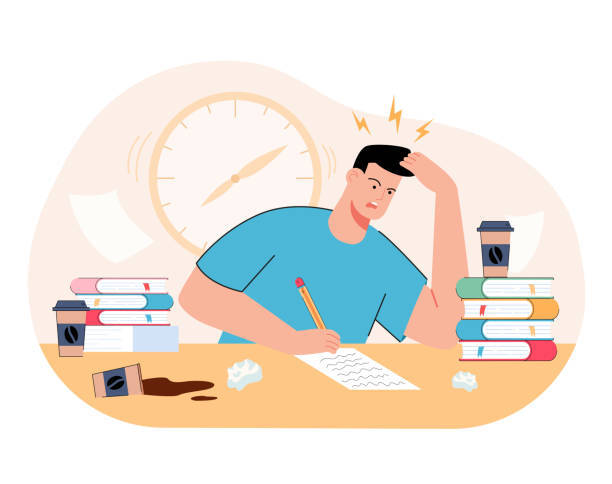
You sit down to study with good intentions. Your assignment is open on the screen, your notes are nearby, and you tell yourself you will get started in a minute.
Then you check your phone.
One message becomes ten minutes of scrolling. You make a drink. You tidy your desk. You watch a video because you need a “quick break.” Before you know it, an hour has disappeared and the assignment is still sitting there.
Most students have experienced some version of this. Academic procrastination is common, but that does not mean you are simply lazy or bad at managing your time. Research increasingly shows that procrastination can be connected to emotions such as anxiety, fear of failure, frustration, and boredom. A 2026 systematic review of 27 empirical studies identified factors including fear of failure, perfectionism, emotional-regulation difficulties, anxiety, and low motivation as important contributors.
The good news is that procrastination is not a permanent personality trait. There are practical ways to make academic work easier to start and easier to finish.
What causes academic procrastination?
I find it useful to think about procrastination as an avoidance cycle rather than a simple lack of discipline.
You have a difficult task in front of you. The task makes you uncomfortable, perhaps because you do not understand what is expected or you are worried that your work will not be good enough. Doing something enjoyable gives you immediate relief, so you avoid the assignment.
For a short time, you feel better.
Then the deadline gets closer. The pressure increases, the task seems even more difficult, and you feel guilty for delaying it. That extra stress can make avoidance even more tempting.
Research supports this connection between emotions and procrastination. For example, a 2024 study involving 292 undergraduate students found relationships between fear of failure, difficulties with emotion regulation, procrastination, and academic satisfaction.
This is why telling yourself to “just work harder” does not always solve the problem.
Sometimes the real question is:
What am I trying to avoid feeling?
If the answer is anxiety, uncertainty, boredom, or fear of producing poor work, you can address that problem directly.
Make the assignment smaller
One of the easiest ways to make an assignment feel more manageable is to stop thinking about the entire assignment.
“Finish my essay” is not a particularly useful task.
It is too large.
Instead, turn it into a series of actions.
For example:
-
Read the assignment question.
-
Highlight the key requirements.
-
Find three useful academic sources.
-
Write down the main argument.
-
Create headings for the body sections.
-
Draft the first section.
-
Add references.
-
Edit the finished draft.
Now you have eight things you can work through instead of one enormous job.
When I am trying to overcome procrastination, I would rather concentrate on the next ten minutes than worry about everything that needs to happen over the next week.
The first step does not need to be impressive. It simply needs to be clear.
Start with five minutes
If you have been avoiding an assignment for days, promising yourself that you will suddenly study for four hours may not be realistic.
Try five minutes instead.
Open the document.
Read the question.
Write a few notes.
Find one source.
Set a timer and work until it rings.
You can stop after five minutes if you genuinely want to. Quite often, however, starting removes some of the resistance. Once the document is open and you have written something, continuing does not feel quite as difficult.
The important part is not the five-minute number itself. It is breaking the habit of waiting until you feel motivated.
Motivation is unreliable. A small action is something you can control.
Create a study schedule you can actually follow
A study timetable only helps if you use it.
It is easy to create an ambitious schedule on Sunday evening and then abandon it by Wednesday because you planned far more work than you could realistically complete.
Instead, look at your week and identify the work that genuinely needs attention.
For example, you might schedule:
-
Monday: 45 minutes of research
-
Tuesday: 45 minutes creating an outline
-
Wednesday: one hour writing
-
Thursday: one hour writing
-
Friday: 30 minutes checking references
-
Saturday: editing
-
Sunday: final proofreading
This gives you several opportunities to work on the assignment instead of relying on one stressful session immediately before the deadline.
Research also supports the relationship between procrastination and self-regulation. A 2023 systematic review of interventions found that self-regulation was a central focus of many approaches designed to reduce academic procrastination.
You do not need the perfect productivity system. You need a schedule that you will actually follow.
Stop waiting for the perfect conditions
“I'll start when I have more time.”
“I'll do it when I feel focused.”
“I need to understand everything before I begin.”
These thoughts sound reasonable, but they can keep you stuck.
University work is rarely completed under perfect conditions. You may be tired. You may not completely understand the question. Your first attempt may be messy.
Start anyway.
If you do not understand the assignment, write down exactly what is confusing you. Then check the course materials or ask your lecturer or tutor.
If you do not know how to structure the answer, create a rough structure and improve it later.
If you are worried that your writing is poor, write the first draft without trying to make every sentence perfect.
Progress gives you something to work with. A blank page does not.
Give yourself permission to write a bad first draft
Perfectionism can look productive.
You might spend twenty minutes changing one sentence because you want the introduction to sound impressive. You might keep researching because you do not feel that you know enough yet.
Meanwhile, the rest of the assignment remains untouched.
Try separating writing from editing.
During the first draft, focus on getting your ideas down. If you cannot remember a reference, leave yourself a note such as “[add source here]” and continue.
Once the draft exists, you can improve it.
This matters because perfectionism has been identified as one of the factors associated with academic procrastination in recent research.
Your first draft does not have to be your final answer.
It just has to exist.
Put distractions out of reach
If your phone is next to you, you do not need to be consciously distracted by it for it to interfere with your concentration.
Every notification creates an opportunity to stop what you are doing.
Before beginning a study session, make distractions harder to access.
Put your phone in another room or switch off unnecessary notifications. Close entertainment websites. Keep only the tabs you actually need for your work.
You can also decide in advance when you will check your messages.
For example:
45 minutes of study → 10-minute break → check your phone.
That is much easier to manage than repeatedly telling yourself, “I will only check it for a second.”
Digital distractions are particularly relevant because research reviews have identified increased screen use, anxiety, and demotivation as factors worth considering when addressing academic procrastination.
Try focused study sessions
You have probably heard of the Pomodoro Technique: work for a set period, take a short break, and repeat.
It can be useful, but you do not have to follow the traditional 25-minute formula.
Some students work better for 25 minutes. Others prefer 40, 50, or 60 minutes.
The point is to create a defined period when you are doing one thing.
For example:
40 minutes: work on the assignment
10 minutes: get up, stretch, have water
40 minutes: continue working
If your concentration starts falling after 25 minutes, use shorter sessions.
There is no prize for forcing yourself to sit at a desk for three hours while accomplishing very little.
Study actively instead of just rereading
Sometimes procrastination disguises itself as studying.
You reread the same chapter, highlight pages, reorganise your notes, and feel busy. But when someone asks you what you actually learned, you struggle to explain it.
Active study is usually more demanding, but it gives you a clearer purpose.
After reading a section, close your notes and ask yourself:
-
What was the main idea?
-
What evidence supports it?
-
Could I explain it without looking at the book?
-
How does it relate to my assignment?
-
What do I still not understand?
This approach turns studying into something you actively participate in rather than something you passively consume.
It can also give you useful material for assignments because you are constantly connecting what you read with your own argument.
Use “if–then” plans
A useful way to deal with procrastination is to decide beforehand what you will do when a predictable problem appears.
For example:
If I start scrolling on my phone, then I will put it in another room.
If I feel overwhelmed by the assignment, then I will spend five minutes breaking it into smaller tasks.
If I miss my planned study session, then I will schedule another session rather than giving up on the entire day.
This is more practical than simply telling yourself, “I won't procrastinate tomorrow.”
You are creating a response for the moment when procrastination appears.
Deal with fear of failure
Sometimes the assignment itself is not the problem.
You are afraid of what the finished assignment might say about you.
What if you get a low grade?
What if your lecturer thinks your argument is weak?
What if everyone else understands the topic better than you?
These thoughts can make avoidance feel safer than trying.
But avoiding the work does not remove the possibility of failure. It only reduces the time available to improve your work.
A better approach is to concentrate on controllable actions.
You cannot control the exact grade you receive.
You can control whether you start early, whether you understand the assessment criteria, whether you research properly, whether you ask questions, and whether you revise your work before submitting it.
Recent research has specifically linked fear of failure and difficulties with emotional regulation to procrastination, reinforcing the idea that the emotional side of academic work deserves attention.
Do not rely on last-minute pressure
Some students believe they work best under pressure because they become highly focused when a deadline is approaching.
There may be situations where a deadline creates a useful burst of concentration. That does not mean leaving everything until the final night is a good academic strategy.
A 2024 meta-analysis covering 96 articles and more than 55,000 participants found a modest negative relationship between procrastination and academic performance overall. It also found that the relationship depended partly on the type of procrastination being measured.
More importantly, last-minute work leaves little room for mistakes.
If you discover that your argument does not work, you need time to change it. If a source does not support your point, you need time to find another one. If your referencing is inconsistent, you need time to correct it.
Starting early gives you that breathing room.
Ask for help when you need it
There is a difference between needing a better study routine and being stuck on a problem you cannot solve alone.
If you do not understand an assessment question, speak to your lecturer.
If you struggle with planning, talk to an academic adviser.
If persistent procrastination is affecting your studies and general well-being, consider using your institution's student support or counselling services.
Academic support can also be useful when you need help understanding how to approach a demanding assignment. If you use an external service, make sure the support helps you develop your own understanding and follows your institution's academic-integrity requirements. For students working on HND coursework, help with hnd assignment can be considered as one source of academic assistance, provided it is used appropriately.
Asking for help early is usually much easier than asking for help the night before submission.
A simple way to stop procrastinating today
You do not need to redesign your entire life to make progress on one assignment.
Try this instead:
1. Choose one task.
Pick the assignment you are currently avoiding.
2. Identify the obstacle.
Are you confused, bored, anxious, distracted, or trying to make the work perfect?
3. Make the task smaller.
Choose one action that can be completed in the next 5–20 minutes.
4. Remove one distraction.
Put your phone away and close anything unrelated to the task.
5. Start a timer.
Work for a short, realistic period.
6. Keep the first attempt imperfect.
Your job is to make progress, not produce the final version immediately.
7. Decide what comes next.
Before finishing, write down the next action you will take.
That final step makes tomorrow easier because you will not have to figure out where to begin all over again.
Final thoughts
Academic procrastination is frustrating, especially when you know exactly what you should be doing and still cannot seem to start.
But beating yourself up rarely fixes it.
A more useful approach is to understand what is behind the delay. Maybe the assignment feels too large. Maybe you are worried about getting it wrong. Maybe you are distracted by your phone. Maybe you simply do not know where to begin.
Once you identify the problem, you can make a specific change.
Make the first step smaller. Give yourself a realistic deadline. Put distractions away. Write a rough first draft. Take intentional breaks. Ask for help when something is genuinely confusing.
Most importantly, stop measuring success by whether you feel motivated.
Sometimes the most productive thing you can do is open the document, write one imperfect sentence, and let that sentence be the beginning.


 Search in Classifieds
 Search in Groups
 Search in Polls
 Search in Members
 Search in Members
 Search in News
 Search in Businesses
 Search in Contests
 Search in Events
 Search in Music Albums
 Search in Music Songs
 Search in Quotes
 Search in Site Team



 Experience: What Guests Can Expect)


Share this page with your family and friends.