Fiber lasers dominate industrial metal processing because they generate light efficiently, deliver it through a flexible cable rather than a mirror path, and produce a beam metals absorb readily. The same technology drives two quite different machines: engravers that mark surfaces, and cutting systems that sever sheet and plate.
The difference lies less in the laser than in how the beam is pulsed, steered and focused. This article covers how fiber laser technology works, how engravers differ from cutters, and what determines quality in both.
What Is Fiber Laser Technology?
A fiber laser is a solid-state laser in which the beam is generated inside an optical fibre whose core is doped with a rare-earth element — usually ytterbium. The fibre is the active medium, not just the delivery route.
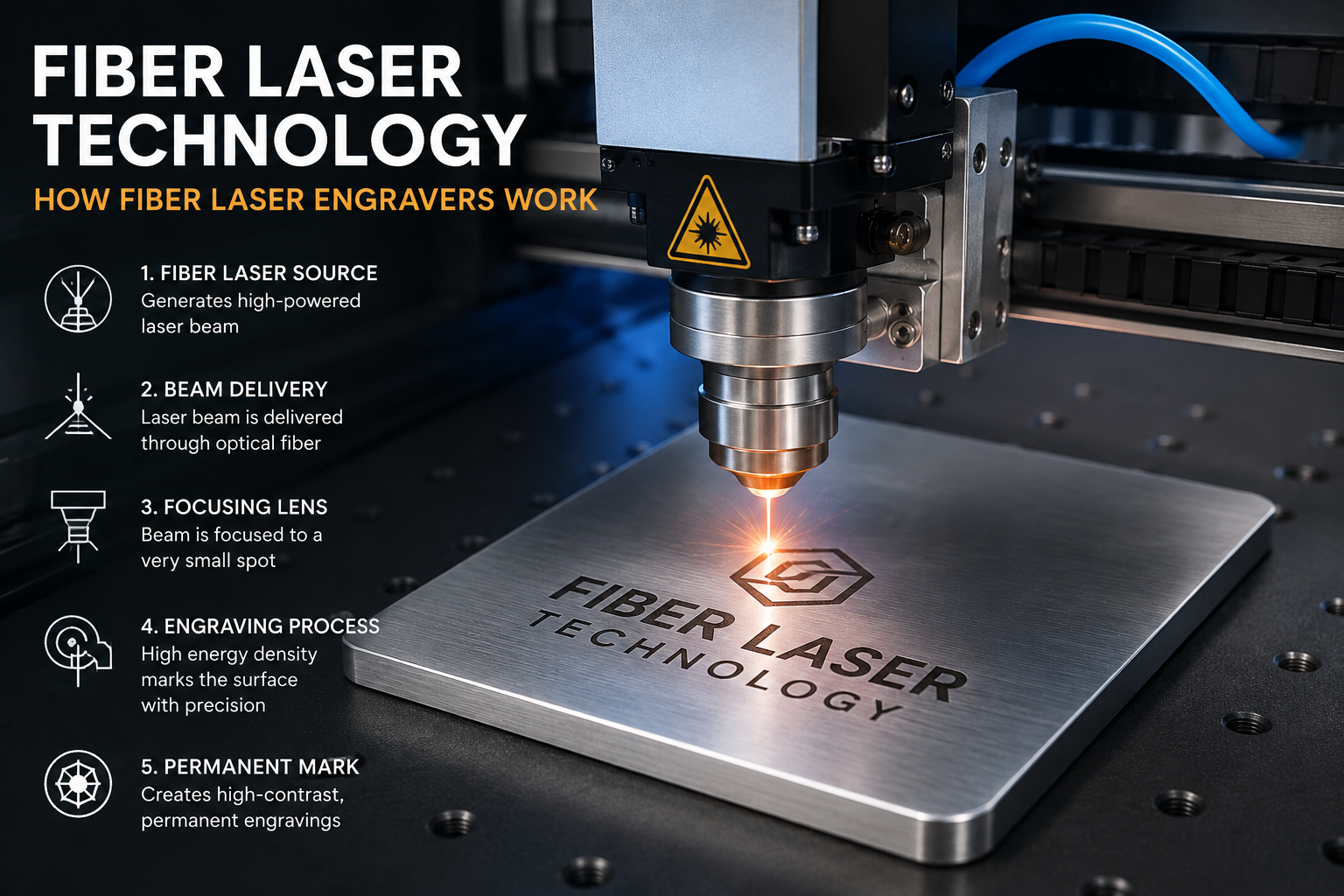
A fiber laser engraver uses a relatively low-power pulsed source and a mirror-based scanning head to mark, etch or engrave a stationary workpiece. The beam moves; the part does not.
A fiber laser cutting machine uses a far higher-power source, typically continuous-wave, mounted on a moving gantry with a cutting head that delivers assist gas alongside the beam. It cuts through material rather than modifying its surface.
Both emit at roughly 1,060–1,080 nanometres, about a tenth of the CO₂ wavelength — the reason fiber laser technology suits metals so well.
How Does a Fiber Laser Work?
- Pump diodes. Banks of semiconductor diodes produce light at a shorter wavelength, supplying the energy input efficiently.
- Rare-earth-doped optical fibre. That light is coupled into a fibre core containing ytterbium ions, which absorb the energy and shift to an excited state.
- Amplification. As excited ions drop back down they emit photons. Passing photons trigger further identical emissions — stimulated emission — so the signal builds along the fibre.
- Beam generation. Fibre Bragg gratings written into the fibre act as mirrors, forming an optical cavity. Light amplifies with each pass until a coherent beam emerges. The narrow, uniform core produces excellent beam quality.
- Beam delivery. The beam travels through a flexible process fibre — no free-space optics to align or contaminate.
- Focusing. Optics concentrate the beam to a very small spot, creating the power density that does the work.
- Material interaction. Concentrated energy heats the metal almost instantly, either altering the surface or melting and vaporising it, depending on power and pulse characteristics.
How Does a Fiber Laser Engraver Work?
An engraver focuses short, high-intensity pulses onto a stationary part while two motorised mirrors steer the beam across the surface at high speed.
Pulsed operation. Rather than emitting continuously, the source releases energy in pulses lasting nanoseconds, concentrating very high peak power into brief bursts while average power stays modest — enough to vaporise a thin surface layer without heating surrounding material.
Galvanometer scanning. Two mirrors on fast servo motors deflect the beam in X and Y. Because only lightweight mirrors move, scanning speeds far exceed any mechanical gantry.
F-theta lens. A flat-field lens keeps the focal point on a flat plane across the working area, so the spot stays sharp at the edges as well as the centre.
Computer control. Software converts artwork into scan paths, controlling power, pulse frequency, speed and hatch pattern.
Engraving, Marking, Etching and Cutting
| Process |
What happens |
Depth |
| Marking |
Surface colour or contrast changes without removing material — annealing steel to a dark oxide, for example |
None |
| Etching |
A very thin surface layer is melted or removed |
Minimal |
| Engraving |
Material is vaporised to create a measurable recess, often over multiple passes |
Shallow to deep |
| Cutting |
Material is melted or vaporised through its full thickness and ejected |
Full penetration |
Annealed marks are useful where surface integrity matters — medical instruments and food equipment — because nothing is removed and corrosion resistance is preserved.
Fiber Laser Engraving vs Fiber Laser Cutting
| Factor |
Engraving |
Cutting |
| Purpose |
Surface modification |
Full separation |
| Typical power |
Tens of watts |
Kilowatt class |
| Emission |
Pulsed |
Usually continuous wave |
| Beam movement |
Galvanometer mirrors |
Gantry-mounted head |
| Assist gas |
Rarely required |
Essential |
| Workpiece |
Stationary |
Supported on a slatted bed |
| Applications |
Serial numbers, logos, data matrix codes |
Sheet metal parts, brackets, enclosures |
The distinction matters when buying. An engraver cannot cut sheet metal, and a cutting machine is poorly suited to fine surface marking. Some fabricators run both.
How Does a Fiber Laser Cutting Machine Cut Metal?
A high-power beam focused to a small spot raises the metal past melting point almost instantly, forming a narrow keyhole. Assist gas delivered through the nozzle ejects molten material before it can resolidify.
Gas choice shapes the result:
- Oxygen reacts exothermically with steel, adding energy to the cut — common on mild steel, leaving an oxide edge
- Nitrogen is inert and delivered at high pressure, giving a clean, oxide-free edge on stainless and aluminium, ready for welding or painting
- Compressed air is economical on thinner material where edge requirements are less demanding
A capacitive sensor maintains constant standoff from the sheet. Before cutting begins, the beam pierces the material at the start point, often at modified parameters, since piercing is more demanding than cutting.
Because a laser metal cutting machine runs entirely on program data, switching between parts needs no tooling change — which is why a laser steel cutting machine suits varied batch sizes.
What Materials Can Fiber Lasers Process?
- Mild and carbon steel — commonly cut with oxygen assist
- Stainless steel — nitrogen for clean edges; marks well by annealing
- Aluminium — effective with nitrogen, though conductivity makes it more demanding
- Brass and copper — once problematic due to reflectivity; modern sources with back-reflection protection handle both
- Galvanised steel — routinely processed, with attention to zinc fume extraction
- Titanium — cut with inert gas, widely used in aerospace and medical work
Fiber lasers are not suited to acrylic, wood or most plastics, which either transmit the wavelength or burn rather than cut cleanly — CO₂ remains appropriate there.
Achievable thickness and quality depend on laser power, machine configuration, optics, gas supply, material properties and process parameters. Check manufacturer cutting charts for your specific materials rather than relying on general figures.
Fiber Optic Laser Cutting Machine Explained
The term reflects the role optical fibre plays in both amplifying and delivering the beam.
In a CO₂ system the beam is generated in a sealed gas tube and routed to the head through aligned mirrors, which need cleaning, alignment and eventual replacement, and are sensitive to vibration and contamination.
A fiber optic laser cutter eliminates that path. The beam travels inside the fibre from source to head, which means:
- No beam-path alignment or mirror maintenance
- The source can sit remote from the head, or feed a robot arm
- Greater tolerance of workshop conditions
- Reduced sensitivity to vibration
Combined with higher electrical efficiency, this is what displaced CO₂ from most metal cutting work.
Key Components of a Fiber Laser System
Common to both machine types:
- Laser source — generates the beam; power rating largely determines capability
- Pump diodes — supply the energy input
- Optical fibre — amplifies and delivers the beam
- Control system — interprets programs and coordinates parameters
Engraving systems add:
- Galvanometer scanner — two fast mirrors steering the beam
- F-theta lens — maintains a flat focal plane across the work area
- Worktable — supports the part, often with Z adjustment to set focus
Cutting systems add:
- Cutting head — focusing optics, gas nozzle and height sensing
- Motion system — servo-driven gantry positioning the head
- Assist gas system — regulated supply at working pressure
- Slatted bed and extraction — part support and fume removal
Advantages of Fiber Laser Technology
- High precision — good beam quality gives a small spot and fine detail
- Fast processing — particularly galvo scanning in marking, and thin-sheet cutting
- Excellent repeatability — consistent results across long runs
- Low maintenance — no laser gas or beam-path mirrors
- Energy efficiency — a high proportion of input becomes usable light
- Minimal consumables — mainly nozzles and protective cover slides on cutting systems
- Reflective metals — capable with suitable protection
- Automation compatibility — integrates with handling, loading and production lines
- No tooling — changing parts means changing a program
What Affects Fiber Laser Cutting and Engraving Quality?
- Laser power — governs speed and thickness capability
- Wavelength — determines how readily a material absorbs the energy
- Pulse duration — shorter pulses reduce heat spread; crucial in fine marking
- Frequency — pulse overlap affects mark appearance and engraving smoothness
- Speed — too fast leaves incomplete cuts; too slow causes excess heat input
- Focus position — often set below the surface for thick cutting, at the surface for marking
- Beam quality — determines achievable spot size
- Material type and thickness — reflectivity, conductivity and alloy all matter
- Assist gas — type, pressure and nozzle condition drive edge quality
- Lens selection — focal length trades spot size against working area
- Calibration — axis alignment and scanner calibration affect dimensional accuracy
Most quality problems trace back to focus position, gas pressure or a contaminated protective lens rather than the laser source.
Fiber Laser vs Other Laser Technologies
CO₂ lasers emit at around 10.6 micrometres, which metals reflect far more — but they cut acrylic, wood, textiles and many plastics that fiber cannot touch, so remain the right choice for non-metals.
Nd:YAG lasers, once standard for marking and spot welding, have largely been superseded by fiber systems with better efficiency and lower maintenance.
UV and green lasers use shorter wavelengths for materials that absorb infrared poorly, or where minimal heat input is essential — fine electronics, some polymers, glass.
Disc lasers compete with fiber at high power through a different architecture, with broadly comparable performance.
No technology is universally superior; match wavelength and pulse characteristics to the material.
Choosing a Fiber Laser Cutter
- Cutting or engraving? These are different machines; be clear which job matters
- Laser power — specify from your typical material mix, not an outlier job
- Thickness range — verify against cutting charts for your actual materials
- Work area — standard sheet sizes for cutting; field size and lens choice for marking
- Speed and accuracy — compare on representative parts rather than headline figures
- Automation — loading and unloading often add more throughput than extra power
- Software — usability and integration with existing CAD/CAM
- Maintenance and consumables — servicing intervals and running costs
- After-sales support — engineer response times, spares availability, local presence
- Safety — enclosure class, interlocks, and extraction suited to your materials
- Total operating cost — electricity, assist gas, consumables and training over the machine's life
On gas: nitrogen consumption is often the largest running cost in cutting stainless or aluminium. Model this before purchase, since an on-site generator may change the economics.
Common Applications of Fiber Laser Technology
- Automotive — brackets, heat shields and chassis components; part marking for traceability
- Aerospace — precision titanium and nickel alloy parts, plus permanent component identification
- Engineering and manufacturing — prototyping and short runs without tooling costs
- Metal fabrication — the largest cutting application: enclosures, panels, frames
- Construction — structural brackets, cladding and architectural metalwork
- Electronics — busbars, shielding and fine marking of components and PCBs
- Signage — lettering, perforated screens and decorative panels
- Jewellery — fine engraving and hallmarking on precious metals
- Industrial marking — serial numbers, data matrix codes and date coding for traceability
Traceability marking is a common driver. Regulated sectors require permanent, machine-readable identification that survives handling and cleaning, which is exactly what annealed fiber laser marks provide.
Frequently Asked Questions
What is a fiber laser engraver?
A machine using a pulsed fiber laser and galvanometer scanning head to mark, etch or engrave stationary workpieces — typically metals and some engineered plastics.
How does a fiber laser engraver work?
Short high-intensity pulses are steered across the surface by two fast mirrors and focused through an f-theta lens, vaporising a thin layer or altering surface colour according to a computer-controlled pattern.
What can a fiber laser cut?
Most metals — mild and carbon steel, stainless, aluminium, brass, copper, galvanised steel and titanium. Not acrylic, wood or most plastics.
Can a fiber laser cut steel?
Yes. Steel is the most common application, usually with oxygen assist on mild steel and nitrogen on stainless for a cleaner edge.
What is the difference between a fiber laser and a CO₂ laser?
Wavelength. Fiber emits around 1.06 micrometres, which metals absorb well; CO₂ emits around 10.6 micrometres, better suited to non-metals like acrylic and wood.
What is the difference between fiber laser engraving and cutting? Engraving modifies the surface using low-power pulses and mirror scanning. Cutting penetrates the full thickness using high continuous power, a moving head and assist gas.
How powerful should a fiber laser cutting machine be? It depends on your material mix and throughput targets. Higher power increases speed and thickness capability but raises electrical and gas consumption — analyse a typical month's work rather than specifying for occasional thick jobs.
Is fiber laser technology suitable for metal fabrication?
Yes — it is the dominant technology for sheet metal cutting, valued for precision, speed on thin and mid-gauge material, repeatability and low maintenance.
Conclusion
Fiber laser technology generates light inside a doped optical fibre, amplifies it along that fibre, then delivers it to a focusing head without free-space optics. The wavelength suits metals, the beam quality allows a very small spot, and the architecture keeps maintenance low.
How that energy is applied determines the machine. Pulse it and steer it with galvanometer mirrors and you have an engraver producing permanent marks at high speed. Run it continuously at kilowatt power through a gantry head with assist gas and you have a fiber laser cutting machine that separates sheet metal cleanly.
Understanding that distinction — and the factors governing quality in each — is what leads to specifying the right system rather than an impressive one.


 Search in Classifieds
 Search in Groups
 Search in Polls
 Search in Members
 Search in Members
 Search in News
 Search in Businesses
 Search in Contests
 Search in Events
 Search in Music Albums
 Search in Music Songs
 Search in Quotes
 Search in Site Team



)


Share this page with your family and friends.