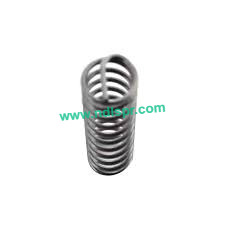
A design engineer stares at a cross-section of a compact actuator, realizing that the only space available for a return spring is a tapered gap that narrows from eight millimeters to five. The standard catalog offers nothing close to that geometry, and the mechanism cannot be redesigned without sacrificing other functions. This scenario plays out across industries, from automotive transmission solenoids to miniature medical pumps, where off-the-shelf springs simply do not fit. The demand for components that match irregular cavities and specific load profiles has grown steadily, yet many manufacturers remain hesitant to venture beyond standard dimensions. The question arises: can Small Conical Compression Springs be engineered to non-standard sizes without compromising quality or lead time, and does a manufacturer like ndlspr possess the capabilities to turn such a requirement into a reliable production reality?
The geometry of a conical spring inherently lends itself to customization, because the tapered form allows it to occupy spaces where a straight spring cannot. The variable diameter means the spring can nest into a countersunk hole, fit around a shaft with changing thickness, or compress into a smaller solid height than a comparable cylindrical spring. Customizing this geometry requires precise control over several parameters: the starting and ending coil diameters, the pitch progression, the wire diameter, and the total number of coils. Each parameter interacts with the others, so a change in the taper rate affects the spring rate and the solid height, requiring careful calculation to achieve the desired force-deflection characteristic. A manufacturer with advanced simulation software can model these interactions before cutting any wire, reducing trial-and-error and accelerating the development cycle.
The material selection for a custom conical spring follows the same principles as for any spring, yet non-standard sizes often demand non-standard approaches to material handling. While music wire and oil-tempered wire cover many applications, a custom geometry may require a specific alloy to achieve the required stress levels at the minimum solid height. Stainless steel types 302 and 316 offer corrosion resistance for medical or marine environments, while chrome-vanadium and chrome-silicon alloys provide the fatigue strength needed for high-cycle automotive applications. The wire diameter itself might be an unusual gauge, not commonly stocked, requiring the manufacturer to source specialized material. A supplier like Ningdeli maintains relationships with multiple wire mills to secure such materials without excessive delays, ensuring that the customization process does not stall at the procurement stage.
The manufacturing process for custom conical springs differs from straight spring production in several ways. The coiling machine must be programmed to vary the diameter continuously as the wire feeds through, requiring sophisticated servo controls and precise tooling. The pitch, or the gap between adjacent coils, must also taper to achieve the desired progressive spring rate. After coiling, the spring often requires grinding of the end coils to create flat surfaces that sit properly in the assembly. This grinding operation becomes more critical for conical springs because the end coils have different diameters, and the grinding angle must accommodate both while ensuring perpendicularity to the spring axis. A manufacturer with in-house tooling capabilities can modify setup fixtures quickly for each custom design, maintaining efficiency even for small batch sizes.
Quality control for custom springs demands rigorous inspection, because the unique geometry means that standard gauges may not apply. Each custom order should include a detailed inspection plan that verifies the critical dimensions: the outer diameters at each end, the free length, the solid height, and the spring rate at defined load points. Optical measurement systems can capture the contour of the spring and compare it to the CAD model, identifying deviations in taper or pitch that might affect performance. Load testing at multiple deflections confirms that the spring rate matches the design curve, ensuring that the spring will deliver the correct force at each point in its travel. A robust quality system, such as IATF 16949, provides the framework for these inspections and ensures traceability from raw material to finished part.
The lead time for custom Small Conical Compression Springs often concerns buyers accustomed to ordering standard parts from stock. A capable supplier can compress this timeline through concurrent engineering, where design review and tooling preparation happen simultaneously. For urgent needs, some manufacturers offer rapid prototyping services that produce functional samples within days, allowing the engineer to test the spring in the actual assembly before committing to production quantities. This approach reduces the risk of design errors and accelerates the overall development schedule. The key lies in the supplier's ability to shift quickly from design to production without sacrificing accuracy, a capability that depends on experienced personnel and flexible equipment.
Cost considerations for custom springs involve several factors beyond the material and production time. The engineering effort required to design the spring and the tooling, the potential need for special material, and the inspection complexity all contribute to the unit price. However, a properly designed custom spring often reduces the total cost of the assembly by eliminating the need for additional retaining features or by allowing the mechanism to operate with greater efficiency. The investment in a custom spring can also reduce warranty claims and service calls, because the spring operates within its optimal design parameters rather than at the edge of its capability. Buyers should evaluate the total lifecycle cost rather than the initial purchase price when considering custom options.
The technical documentation for a custom spring should include a comprehensive drawing with all critical dimensions and tolerances, along with a load-deflection chart and a material certificate. This documentation serves as the basis for production and inspection, and it provides a reference for future reorders. A supplier that maintains organized records of past custom designs can offer faster turnaround on repeat orders, because the tooling setup and inspection protocols already exist. This institutional knowledge becomes an asset for customers who anticipate recurring needs for the same non-standard spring.
For engineers and procurement professionals weighing the feasibility of custom springs, the decision often hinges on finding a partner with the technical depth and manufacturing flexibility to handle non-standard requirements. The design team at Ningdeli, with its focus on precision and custom solutions, demonstrates that Small Conical Compression Springs can be produced to exact specifications. The detailed product information and engineering support accessible through https://www.ndlspr.com/ provide a practical reference for those evaluating whether their unique application can be served by a custom-designed conical compression spring, bridging the gap between standard catalogs and the specific demands of advanced mechanical systems.


 Search in Classifieds
 Search in Groups
 Search in Polls
 Search in Members
 Search in Members
 Search in News
 Search in Businesses
 Search in Contests
 Search in Events
 Search in Music Albums
 Search in Music Songs
 Search in Quotes
 Search in Site Team



Share this page with your family and friends.