Clear, accurate writing matters whether we are preparing an academic assignment, publishing a blog post, writing business communication, or creating website content. As artificial intelligence becomes part of everyday writing, new tools are helping us improve text more efficiently. An AI proofreader is one such tool, designed to identify writing issues and suggest improvements in grammar, spelling, punctuation, clarity, and sentence structure.
For anyone who writes regularly, an AI proofreader can provide a convenient first review before content reaches its final audience. However, the best results come from combining automated suggestions with thoughtful human editing.
What Is an AI Proofreader?
An AI proofreader is a software tool that uses artificial intelligence and natural language processing to analyze written content. It examines sentences and identifies potential mistakes or areas that could be improved.
Traditional proofreading requires manually reading every sentence and checking grammar, spelling, punctuation, and readability. An AI proofreader can perform an initial review much faster, making it useful for longer documents and frequent writing tasks.
Depending on the platform, an AI proofreader may identify:
- Grammar mistakes
- Spelling errors
- Incorrect punctuation
- Awkward sentence construction
- Repetitive wording
- Unclear phrases
- Inconsistent capitalization
- Word-choice issues
- Readability problems
The goal is not simply to correct mistakes but to help make writing clearer, smoother, and easier to understand.
How Does an AI Proofreader Work?
AI proofreading tools use language models and computational linguistics to understand relationships between words and sentences. Instead of checking every sentence against a simple grammar rule, modern systems can consider the surrounding context.
For example, a word may be spelled correctly but still be inappropriate for a particular sentence. Context-aware analysis can help identify these issues and recommend a more suitable expression.
Grammar and Spelling Analysis
One of the most common uses of an AI proofreader is finding grammatical and spelling mistakes. The tool can identify problems involving verb agreement, sentence structure, misplaced punctuation, missing words, and common spelling errors.
This can be particularly useful when reviewing large documents where small mistakes are easy to overlook.
Improving Clarity and Readability
Good writing is not only grammatically correct; it should also communicate ideas effectively. An AI proofreader can highlight sentences that appear unnecessarily complicated, repetitive, or difficult to follow.
Writers can then decide whether to simplify the wording, divide a long sentence, or reorganize an idea.
AI Proofreader for Students
Students often work on essays, reports, research assignments, and presentations. An AI grammar checker can help identify surface-level writing problems before submission.
It can be useful for checking grammar, punctuation, spelling, and readability while allowing students to review suggested changes themselves. This makes proofreading part of the learning process rather than simply replacing the student's own editing.
Students should also follow their school's or institution's policies regarding AI-assisted writing and editing.
AI Proofreader for Businesses and Content Creators
Professional communication requires accuracy and consistency. A small grammar mistake in an email, product description, report, or website page can affect how a business is perceived.
Businesses, marketers, bloggers, and content teams can use AI proofreading during their editing workflows. It can help review website copy, social media content, newsletters, articles, product descriptions, and internal documents.
Why Context Matters
Automated suggestions are not always perfect. A sentence may intentionally use informal language, industry terminology, or a particular brand voice. An AI proofreader may recommend changing wording that is actually appropriate for the intended audience.
For this reason, writers should evaluate suggestions instead of accepting every recommendation automatically.
AI Proofreader vs. AI Detector
An AI proofreader and an AI detector have different purposes.
An AI proofreader focuses on improving writing by identifying potential errors and suggesting revisions. An AI detector analyzes text for patterns that may indicate that it was generated or assisted by artificial intelligence.
These tools can therefore complement each other. A writer might use an AI proofreader to improve clarity and correctness while using an AI detector as an additional analytical check.
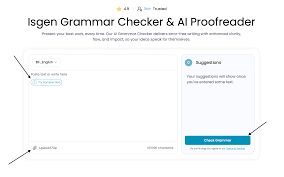
Using AI Proofreading With isgen.ai
Isgen provides AI-focused tools designed to support modern content workflows. An AI proofreader can be particularly useful for writers who want to review their content for language quality before publishing or submitting it.
Whether we are working on an academic document, website article, marketing copy, or everyday communication, proofreading can help us catch issues that may otherwise remain unnoticed.
The most effective approach is to use AI suggestions as an editing aid while maintaining human control over the final version.
Best Practices for AI Proofreading
Review Every Suggestion
Not every automated recommendation will match the intended meaning or tone. We should consider the context before accepting a change.
Preserve the Original Voice
Good proofreading should improve communication without removing the writer's personality. A natural writing style should remain intact.
Combine Automated and Human Editing
AI can identify many common issues quickly, but human readers are better positioned to judge meaning, tone, context, and audience expectations.
Check Facts Separately
Proofreading focuses primarily on language quality. It does not automatically guarantee that every statistic, claim, name, or source is factually correct. Important information should still be verified independently.
Conclusion
An AI proofreader can make the editing process faster, more convenient, and more consistent. By identifying grammar, spelling, punctuation, readability, and sentence-structure issues, it gives writers an additional layer of support before their content reaches readers.
However, effective proofreading is more than correcting individual mistakes. Strong writing requires context, purpose, accuracy, tone, and a clear understanding of the audience. AI tools can assist with many parts of this process, but human judgment remains essential.
As artificial intelligence continues to transform digital writing, platforms such as isgen.ai can help writers combine technology with careful editing. Used thoughtfully, an AI proofreader becomes more than an error-finding tool—it becomes a practical part of a modern workflow for producing clear, polished, accurate, and engaging content.


 Search in Classifieds
 Search in Groups
 Search in Polls
 Search in Members
 Search in Members
 Search in News
 Search in Businesses
 Search in Contests
 Search in Events
 Search in Music Albums
 Search in Music Songs
 Search in Quotes
 Search in Site Team



Share this page with your family and friends.